
A Mural That Tells Fredonia’s Story
What would it take to build a college in a small Western New York community in the early 19th century?
Timber. Stone. Bricks. Glass. Grain. Hay. Rye. Cattle. Pigs. Leather.
Money helped, too. So did store credit, skilled craftsmen and, most importantly, the willingness of local residents to contribute their time and labor.
All of those things—and the determination behind them—are part of the story told in a new mural celebrating the bicentennial of SUNY Fredonia.
Created by Fredonia alumna and artist Erin Ruffino ’19, with generous support from the Southern Chautauqua Federal Credit Union, the six-panel mural traces nearly 200 years of higher education in Fredonia. It brings together historic photographs, campus landmarks, student traditions, artistic and athletic achievements, and the people who have shaped the institution.
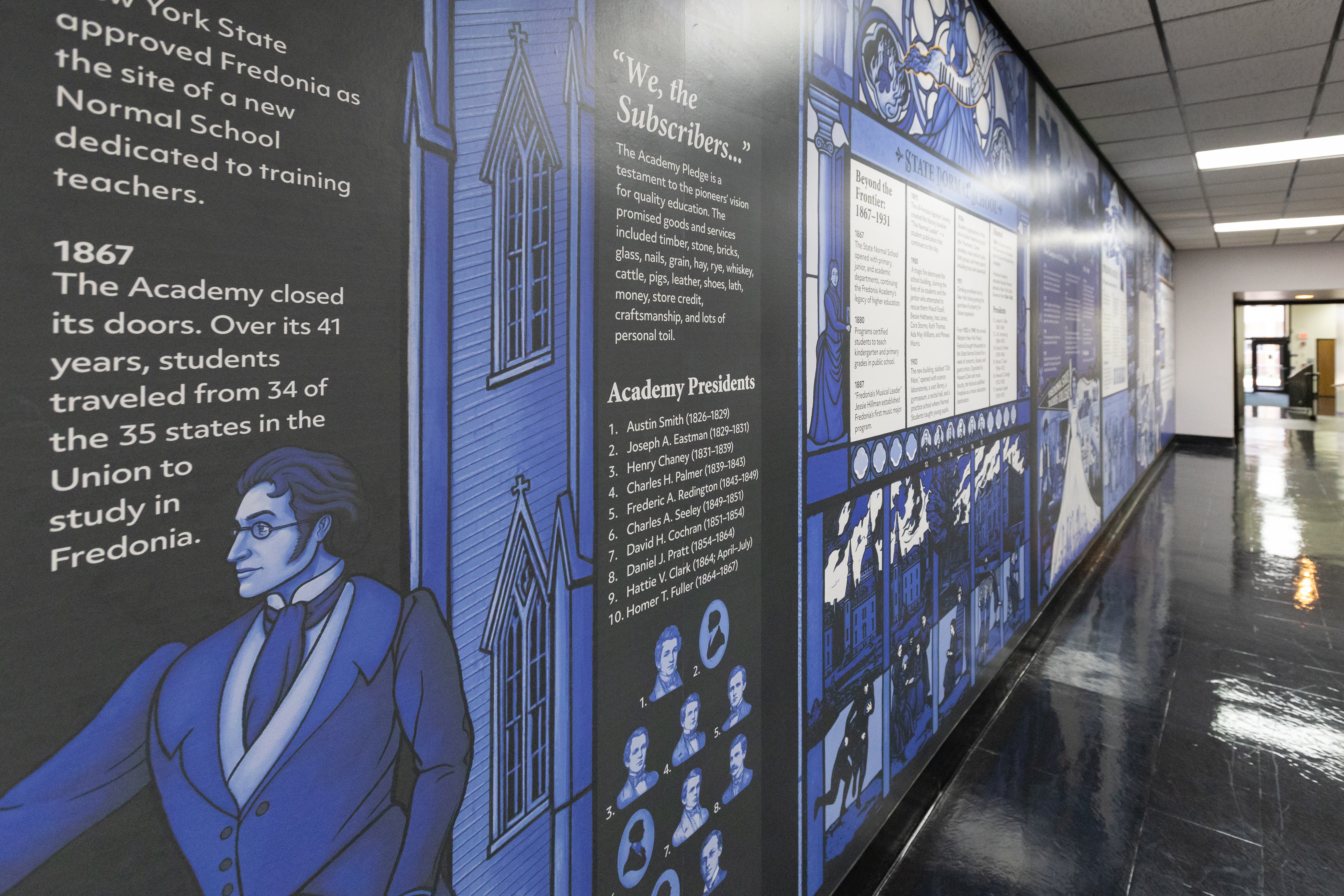
Across the six panels, Fredonia's history unfolds through the experiences of the people who have lived it: the settlers who built Fredonia Academy, the teachers and students of the State Normal School, the generations who created campus traditions, the students who found their voices through organizations and publications, and today's students who are carrying that story forward.
The mural invites viewers to do the same thing that history itself asks of us: look closely.
A Fredonia artist tells Fredonia's story
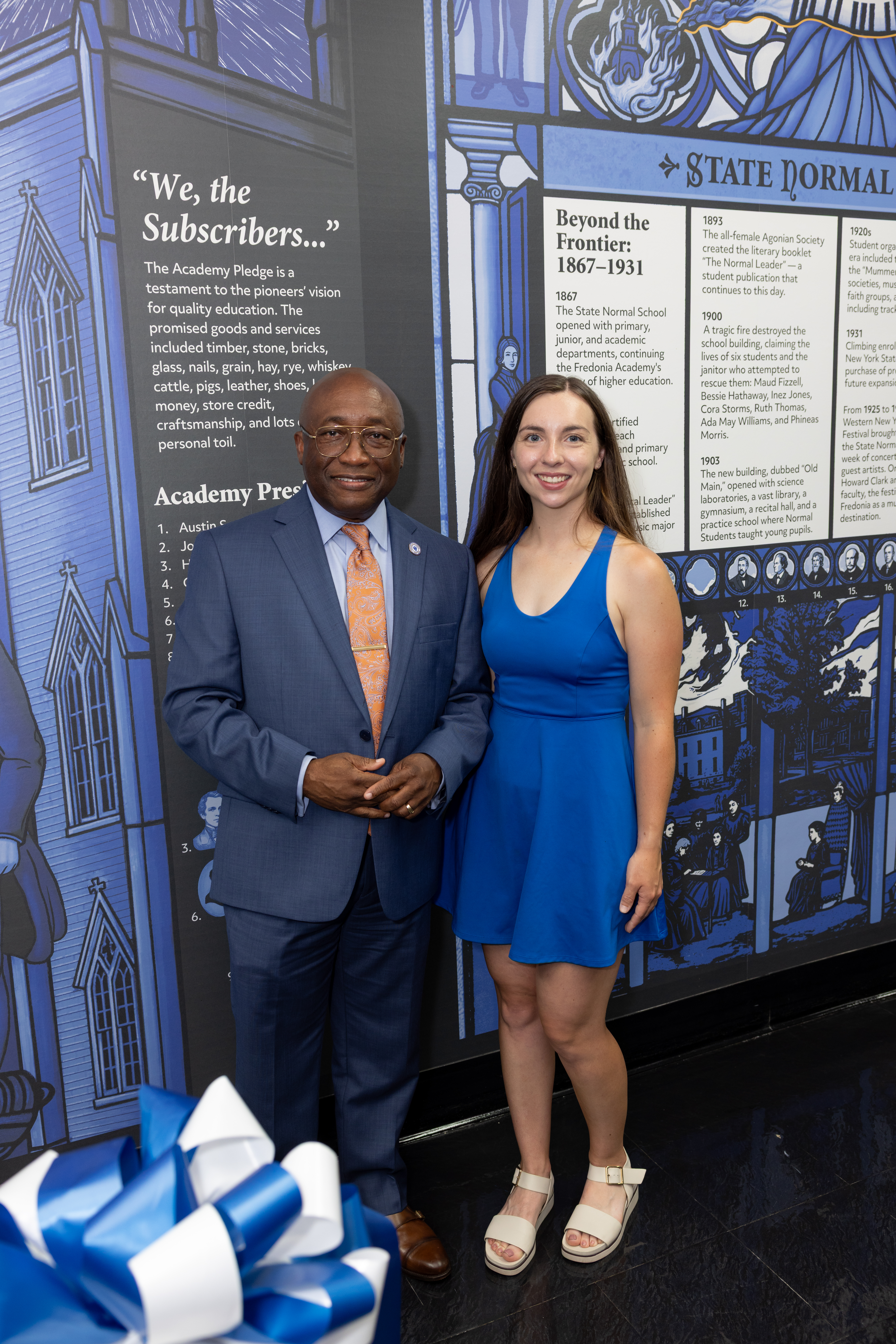
Ruffino, who earned a B.F.A. in Drawing & Painting from SUNY Fredonia in 2019, has established herself as a muralist and fine artist throughout Western New York. Her murals include work for businesses and institutions such as the Roger Tory Peterson Institute in Jamestown, while her graphite drawings have appeared in ImagineFX, Artist Network, American Art Collector and Fine Art Connoisseur.
For the bicentennial project, Ruffino combined that artistic experience with an extensive exploration of Fredonia's history.
Working with Mandi Shepp, Coordinator of Archives and Special Collections at SUNY Fredonia, and Maxwell Walters, Curator of the Darwin R. Barker Museum, Ruffino developed a visual story that moves through the university's history while leaving room for the details that make that history memorable.
The first panel begins with Fredonia Academy and the remarkable community effort that made the school possible.
On one side, the mural depicts the goods and services pledged by local settlers to establish the academy. Timber, stone, bricks, glass and nails appear alongside grain, hay, rye, whiskey, cattle, pigs, leather and money. Craftsmen and labor are represented as well, reflecting a community that invested its resources and its work in creating an institution of higher education.
Above them, settlers clear the land.
On the other side, the tower of Fredonia Academy rises prominently above the scene. A glowing gaslight illuminates the tower, creating a powerful image of education as a beacon. Portraits of the institution's presidents are incorporated into the tower, linking Fredonia's earliest days to the leadership that followed.
The story then moves into the State Normal School era, where Ruffino draws inspiration from one of Fredonia's most distinctive historic images: the stained-glass window of the Normal School Chapel.
At the center of the panel stands Jessie Hillman before the chapel window. Nearby, a depiction of the original school building engulfed in flames recalls a devastating moment in campus history. But the smoke rising from the fire takes an unexpected form. It becomes a piano, then a flowing musical staff held in Hillman's hands.
The transformation captures something fundamental about Fredonia's identity: music and the arts became part of the campus's response to adversity and would remain central to its character.
The surrounding imagery expands that story. The campus fountain where Music Festival students gathered for photographs appears alongside scenes of academic, athletic and artistic life. Faculty members frame the composition, representing the educators who influenced generations of students, while historic buildings and portraits of university presidents connect the panel's individual moments to the institution's larger evolution.
The details are the story
As the mural moves into the middle decades of the 20th century, the emphasis shifts toward the experience of being a Fredonia student.
One scene moves from the campus library to students participating in World War II harvests, recognizing their contribution to the war effort. Nearby, a photograph of May Queen Lucille Laughlin following her 1931 coronation recalls a tradition that began during the State Normal School era and became part of campus life for generations.
Other images capture the rhythms of student life: winter carnival, gymnasium classes, archery, the music building and the freshman beanies once worn by new students.
There are also quieter moments. A teacher and student working together outside the science laboratory represents the educational opportunities at the heart of the institution.
By the fourth panel, Fredonia's identity as a modern university is taking shape.
Historic photographs document the expansion of the campus and the construction of new academic buildings and facilities as enrollment grew. A yearbook-like strip captures student organizations, events, performances and everyday campus life. Images of athletics, leadership and academic achievement show a university whose educational mission increasingly encompassed a broad range of experiences.
The fourth panel marks the birth of Fredonia's Blue Devil mascot, whose official birthday is recognized as January 18, 1937—the date associated with the first documented use of the Blue Devils name.
It is one of many small details that rewards a closer look.
The fifth panel takes that idea even further, surrounding the viewer with the voices and memories of Fredonia students. Designed with the appearance of a composition notebook, it places The Leader, Fredonia's student newspaper, prominently at the top. Headlines, photographs and graphic elements capture changing campus issues, student achievements and significant moments.
Around them are snapshots of organizations, performing arts, athletics, traditions, leadership and service.
Together, they tell another part of the Fredonia story: an education happens in classrooms and laboratories, but it also happens in rehearsal rooms, on athletic fields, through student organizations, in campus publications and in the friendships and experiences that students carry with them after graduation.
Bringing 200 years into the present
The final panel brings the story to today's SUNY Fredonia.
Panoramic photographs stretch across the top of the composition, showcasing the contemporary campus and its landscape. A large letter F frames images representing academic excellence, student research, artistic achievement, community engagement and campus leadership.
The word "FRED" and a graduation cap point toward one of the university's most important outcomes: students completing their education and carrying what they learned into the world.
Other images connect Fredonia's present to its continuing growth. A photograph of the ribbon-cutting for the Track and Field Complex represents the university's investment in its campus and facilities. A photograph of President Stephen H. Kolison Jr. with New York State Governor Kathy Hochul reflects Fredonia's place within the larger Western New York community.
Below it all, the campus landscape stretches toward the horizon, with its trees and the Three Man Hill sculpture grounding the scene in a place that generations of students have called home.
The final panel looks ahead as well as back.
Its concluding message centers on one of the mural's most important ideas: Fredonia's greatest legacy is found in its people. Buildings can be preserved and traditions remembered, but the enduring impact of a university is measured in what its students do with the education and experiences they receive.
History you can explore
A project spanning nearly 200 years requires more than artistic imagination. It requires research, careful documentation and an understanding of the difference between a historical artifact and a historical story.
Shepp and Walters served as historical advisors throughout the project, helping Ruffino research the people, photographs, places and events represented in the mural and ensuring that its many details accurately reflect Fredonia's past.
Their work, together with Ruffino's artistic vision, gives the mural a quality that rewards repeated viewing.
From a distance, the six panels form a sweeping portrait of an institution evolving across two centuries.
Up close, the story becomes much more personal.
You might notice the goods pledged by early settlers to build Fredonia Academy. You might follow the smoke from the Normal School fire as it becomes music. You might recognize a campus tradition, find a familiar building or discover a photograph of students whose lives unfolded here decades before your own.
That is what makes the mural especially fitting for Fredonia's bicentennial.
The institution has changed enormously since those first settlers gathered the resources to build Fredonia Academy. Its campus has grown. Its academic mission has expanded. Its students, traditions and opportunities have evolved.
Yet the essential thread remains remarkably consistent: people coming to Fredonia to learn, to participate, to discover what they can do and to take that experience with them into the world.
Two hundred years of that story are now gathered in one place.
And there are still stories being added.